Pictorial Overview:
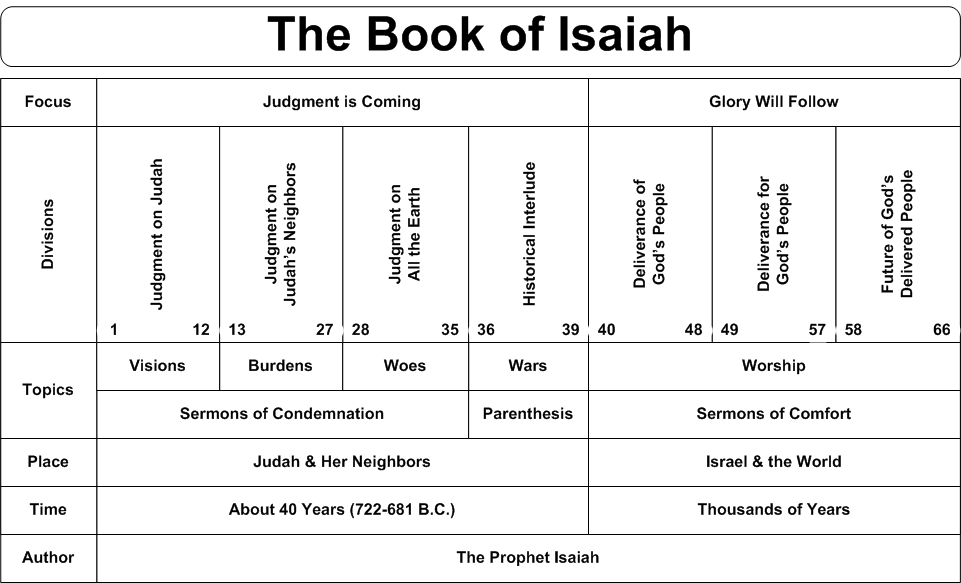
Chart of the Book of Isaiah.
Outline/overview of Isaiah (loosely adapted from Ortlund, McArthur):
- Isa 1-5: God indicts his people for their sins (Judah)
- Isa 6-12: God reveals grace through judgment for his people
- Isa 13-27: God reveals judgment and grace for the world
- Isa 28-35: God pronounces woe to worldly alliances
- Isa 36-39: Good & bad Hezekiah; God alone is good, and is man's only hope
- Isa 40-55: Comfort for God's exiles: "The glory of the Lord shall be revealed"
- Isa 56-66: How to prepare for the coming glory: "Hole fast my covenant"
[The prophesies of ch. 1-39 addressed Judah in her situation during Isaiah's ministry (739 B.C. - 686 B.C.). The prophesies of ch. 40-66 address Judah as though the prophesied Babylonian captivity (Isa 39:5-7) were already a present reality, though the captivity did not begin until 605-586 B.C. ]
Isaiah may be divided into 3 sections, where each section focuses on/addresses:
- (Isaiah 1-39) God's judgment on Israel by Assyria (740-700 B.C.)
- (Isaiah 40-55) the exiles in Babylon (600-539 B.C.)
- (Isaiah 56-66) the remnant after her return from Babylon (539-500 B.C.)
Outline of Isaiah (John MacArthur):- Judgment (1-35)
- Historical Interlude (36-39)
- Salvation (40-66)
Outline of Isaiah (ESV Study Bible - Ray Ortlund)- Introduction: "Ah Sinful Nation" (1-5)
- God preserves a remnant for his people through grace: "Your guilt is taken away" (6-12)
- God's judgment and grace for the world: "We have a strong city" (13-27)
- God's sovereign word to the world: "Ah" (28-35)
- Historical transition: "In whom do you now trust?" (36-39)
- Comfort for God's exiles: "The glory of the Lord shall be revealed" (40-55)
- How to prepare for the coming glory: "Hold fast to my covenant" (56-66)
Brief Intro: The central theme of Isaiah is God himself, who does all things for his own sake.
Isa. 48:11 says,
"For my own sake, for my own sake, I do this. How can I let myself be defamed? I will not yield my glory to another." When God called him, Isaiah discovered to his dismay that God was not sending him to save Israel but to harden their unrepentant hearts (Isa. 6:9,10). But he calls the godly to seek the Lord, to hope for God's kingdom, to experience God's peace within, and to respond with faith to God's new acts of redemption. In the end a godly remnant will survive the judgment (Isa. 6:13).
- Isaiah means "The Lord is salvation" (similar to Joshua, Elisha, and Jesus).
- Isaiah is quoted > 65 times, far more than any OT prophet, and mentioned by name > 20 times.
- He is married, has 2 children (Isa. 7:3, 8:3), and according to tradition was martyred by being sawn in 2 (Heb. 11:37).
- He ministered for ~40 years from 740 B.C. (Isa.6:1 - the year King Uzziah died) till after 700 B.C. (37:38 - death of Sennacherib). The kings who ruled in Judah during that time: Uzziah, Jotham, Ahaz, and Hezekiah (Isa. 1:1). It was an era of great political turmoil due to Assyrian imperialism.
- Since Isaiah prophesied during the period of the divided kingdom, he directed the major thrust of his message to the southern kingdom of Judah.
- Also known as the "evangelical Prophet," Isaiah spoke much about the grace of God toward Israel, particularly the last 27 chapters (Isa. 40-66). The centerpiece is Isaiah's unrivaled chap. 53, portraying Christ as the slain Lamb of God.
The first section of Isaiah (chap. 1-5) is the introduction, where Isaiah rebukes the people of God in order to place them under the judgment of God's word. His lament is "Ah, sinful nation" (Isa. 1:4).
 Isa. 1:2-2:5 is a microcosm of the book's message, where the Lord announces his basic charge against the people: they have received so much privilege from God and ought to be grateful children, but instead "they have despised the Holy One of Israel" (Isa. 1:2-4). His indictments are to bring them to repentance, or to preserve a remnant who will repent (Isa. 1:5-9). But the people seemed very faithful in keeping their religious traditions, yet their hearts were far from God, as evidenced by their unwillingness to protect their own weakest members (Isa. 1:10-20, 23). Yet, God appeals to them: “Come now, let us reason together, says the LORD: though your sins are like scarlet, they shall be as white as snow; though they are red like crimson, they shall become like wool" (Isa. 1:18).
The Lord called his people to be the embodiment of faithfulness in this world. Yet they were filled with rampant unfaithfulness at every level--personal, religious, social (Isa. 1:21-31). Despite his people's hard unrepentant hearts, God himself will fulfill his own purpose through those who would commit themselves to "walk in light of the Lord" (Isa. 2:1-5).
Posted via email from benjamintoh's posterous
 Isa 66:1-24 explains that though the worship of God is violated now, in the future falsehood and hypocrisy will be judged, true worship will spread, and God will be honored forever. True worship will last forever.