10/15/2010

My Way or The Highway (Proverbs 16)


We feel so strongly and insistent about the way things should be: "My way or the highway is surely the best way!" But Proverbs 16 tells us some foundational truths.

16:1 "To man belong the plans of the heart, but from the LORD comes the reply..."

16:9 "In his heart a man plans his course, but the LORD determines his steps."

No matter what we propose (1a,9a), it is God who disposes (1b,9b). For "The Lord has made everything for its purpose" (16:4). We may think that our heart and motives are pure and right, "but the Lord weighs the spirit (motives)" (16:2). Whether we like it or not, all things are under God's sovereignty and serve His purposes. Therefore, the wise approach to life is to "Commit your work to the Lord, and your plans will be established" (16:3). Though Jesus pleaded to his Father to take away his unbearable cup of sorrow and death, he said, "yet not my will, but yours be done" (Lk 22:42).

16:32 "Better a patient man than a warrior, a man who controls his temper than one who takes a city." It takes an exceptional mighty man and leader to conquer a city. But the greater man is one who is able to exercise self-control and not lose his temper or lose his spirit during a time of weakness, temptation, crushing disappointment, or unexpected crises (14:17,29). Even just in terms of patience and forbearance, Jesus is the greatest man.

Posted via email from benjamintoh's posterous

10/14/2010

Are your Words Thoughtful, Timely, and True? (Proverbs 15:1-4)

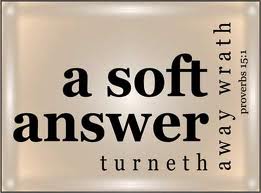
Prov. 15:1-4 "A soft answer turns away wrath, but a harsh word stirs up anger" (1). Words are gifts of God, given only to man in all of creation. Words used wisely are thoughtful, timely, and true. We should speak the right thing (true) in the right way (thoughtful) at the right time (timely). But if we don't, we invite wrath (1), express our stupidity (2), discourage others (4), even promote evil (28), especially through gossip (Prov. 16:28; 18:8) and slander. When we acknowledge his divine omniscience and guard our heart in the fear of God, God will give us wisdom to use our words to honor God and bless people.

Prov. 15:3 "The eyes of the Lord are in every place, keeping watch on the evil and the good." That God sees and knows everything about everything and everyone is called divine omniscience. To a believer, it is most encouraging that God sees and knows me. When I am hurt and wounded, there is no greater comfort in all the world than to know that God sees and knows my frail, fragile, wounded heart. But to an unbeliever it is upsetting, dreadful and infuriating that God knows all the goings on in their heart, and that they can never hide from God.

Prov. 15:22 "Plans fail for lack of counsel, but with many advisers they succeed" (NIV). Proverbs repeatedly encourages us to take advice (Prov. 13:10), listen to advice (Prov. 12:15), and to have many advisors (Prov. 11:14). If we just humble ourselves and learn to listen, we'd be a whole lot wiser. But we fail to listen, and so remain unwise (Prov. 21), when we find it too humbling to listen to advice.

Faithful shepherding has tangible benefits, not just for the church, but also for the pastor.

I love this post by Darrin Patrick about shepherding.

1. Shepherding Prepares the Pastor for Living

When you:
  • deal with the sin of others, you become more aware of your own sin.
  • shepherd the stubborn, you see your own stubbornness.
  • shepherd the selfish, you see your own selfishness.
  • shepherd the broken, you inevitably see your own brokenness.
  • see others obey, you want to obey.
  • see others use their gifts effectively, you want to use your gifts effectively.

The Holy Spirit reveals sin, empowers obedience, and imparts gifts. Both the Greek and Hebrew words for “spirit” mean “air” or “breath.” The English word “spirit” comes from the Latin spiritus, which also means “air” or “breath”. This is where we get words like respiratory (breathing) and expire (no more breathing). It is also where we get the word inspire. It’s as if when the Spirit is at work in those whom we counsel, we pastors are, by the same Spirit, inspired to repent, believe, and obey with the best gifts we have.

2. Shepherding Prepares the Pastor for Preaching

The more time you spend deep in pastoral care with people throughout the week, the more you will know how to contextualize your message, address specific sins, confront resistance to truth, expose cultural idols, and make concrete applications on Sunday.

3. Shepherding Helps Your Influence in Preaching

Shepherding humbles you and kills the self-righteousness and pride that prevents people from receiving your delivery of the gospel. When you have spent real time with real people, you gain an emotional connection with your hearers that engages both their minds and their hearts.

Many pastors are like the tin man: a hard outer shell with no heart. Though they preach the truth, they do not connect with their listeners. When your people know that you are involved not just in the “sweet by and by,” but in the “nasty now and now” of their lives, they tend to believe what you are saying. They might even, miracle of miracles, apply what you are preaching.

4. Shepherding Helps You Stay Close to Jesus

There is something about dealing with the enormity of people’s sin that necessitates staying very, very close to God. In preaching, it is easier to hide a lack of spiritual connection with God through good preparation and raw ability. But the unpredictability and sheer emotional content of pastoral work confronts you with your own necessity for a savior.

In preaching, you can prepare what you will say ahead of time. In pastoral work, there is a lot of room for insecurity and anxiety as you wrestle with the questions, objections, and arguments of your people in real time—it drives you to dependence on God.

5. Shepherding Tests the Genuineness of Your Faith

The fiery furnace of pastoral work can burn off the many rough edges of your personality and cause healthy refining and growth. Pastoral work, the real brass tacks of dealing with the day-to-day struggles of your people, does more to humble and test a minister’s spirituality than study itself could ever do.

I’ve heard Tim Keller say preaching is like firing artillery; it is a relatively safe and clean job because sharp shooters are removed from the actual battle line. But pastoral work is like being in the infantry. It is hand-to-hand, eyeball-to-eyeball combat. Being a good preacher may or may not make you a better shepherd, but being a good shepherd will definitely make you a better preacher.

This post is adapted from Darrin Patrick's book Church Planter: The Man, the Message, the Mission, available now.

Post: http://theresurgence.com/2010/09/27/5-ways-shepherding-helps-a-pastor-grow?utm_source=feedburner&utm_medium=feed&utm_campaign=Feed%3A+TheResurgence+%28The+Resurgence%29

10/13/2010

Pastor to Fellow Pastor in Crisis

"We do Christ wrong when our pursuit of others feels like we are mainly angry at how they let us down or broke the rules. They need to see in us a resting in the gospel so that it looks better than what they have. It is an irony. To win those who are breaking our heart, we must strive to enjoy the great heart-sustainer more than ever."

John Piper's personal email to Mark Dever quoted in For the Fame of God's Name, 462

10/12/2010

Godliness Gives Stability and Vitality (Proverbs 14:26,27)

14:26,27 "The fear of the Lord" (26,27) and one who "fears the Lord" (2) is not the dread and terror of God, but a proper respect and reverence, resulting in a right relationship with God. Godliness (the fear of the Lord) protects the soul by its solidity (26) and its vitality (27), giving confidence, like one in an impenetrable fortress (26), and a richness and an abundance of life (27). Evil not only attacks but attracts, so the man of God must know something stronger and better. When godly parents live in the fear of God (again, not the dread of God, but a loving right relationship with God), they bless their children (26b) more than all of Dr. Phil's "good advice" ever can.

14:4 Neat But Negative: I had not stopped to think what this meant, just skimming past with a blank mind! Orderliness can reach the point of sterility. When there is no oxen the farmer doesn't have to clean the barn. But oxen, being much stronger than a man, can produce an abundant harvest, bringing much benefit to the farmer. So it may be necessary to accept upheaval, and a big mess to clear up, as the price of growth. An empty stable may be clean (requiring no unpleasant work), but it won't produce an abundance.

14:10 The 2 extremes of emotion: bitterness and joy can sometimes only be known and experienced peronally and privately between oneself and God. On occasion, perhaps a trusted friend and confidant may share the depth of his inmost heart.

10/11/2010

Wisdom is Found in Those Who Take Advice (Proverbs 13:10)

Some topics covered in Proverbs 13 include:
  • teacheability (1),
  • mouth/speech control (2,3),
  • listening to/taking advice...again (10),
  • being influenced (20),
  • disciplining children (24).
13:20 Education by Friendship (Walk with the Wise--Become Wise). The simple lesson is that we become like those whose company we keep. This is the power of association to shape character, for regular companions inevitably influence each other, for good or ill. Thus, Christians are encouraged to "not give up meeting together, as some are in the habit of doing" (Hebrews 10:25).

13:1 Are you teacheable? Teaching and instruction--beginning from a child's father at home--produces a wise child (1a). Refusing this or lacking this often results in a mocker or a scorner, who is a fool in the last stages of folly (26:12).

13:2,3 How hard it is for anyone to guard thier lips; how easy to speak rashly, bringing ruin (3; 10:14; 18:7). Thus, fools who ruin themselves abound, while one of the clearest marks of wisdom is the ability to control the tongue.

13:4 Unfulfilled craving, or full satisfaction? The difference between laziness and diligence.

13:7 Don't take a man at his own valuation. Things are not always as they seem.

13:10 In Proverbs, wisdom is repeatedly correlated with those who take advice (13:10), those who listens to advice (12:15), and those who have many advisors (11:14). The proud, lacking wisdom, produce quarrels, strive and divisions (10a). How proud is our hard heart that instinctively and spontaneously rejects advice, and become foolish!

13:13 The importance of respecting and revering words and commands.

13:24 When a child is lovingly disciplined (to drive out folly and rebellion), they grow up loving their parents. When a child is not disciplined for fear of hurting them, they "hate" their parents! By witholding discipline, we are inadvertently producing a generation of adults who routinely ship their aging parents off to nursing homes!

A Wise Man Listens to Advice (Proverbs 12:15)

12:1,2 Stupidity and wisdom, pride and humility. The way to be stupid is to is to be proud (2a), and to think of oneself as above criticism (1b). To heed instruction (10:17) and correction reflects humility and leads to wisdom (2).

12:4 It's incredible how much "an excellent wife" (ESV), "a wife of noble character" (NIV) establishes the honor and joy of her husband (Proverbs 31:11,12,23).

12:10-12 The righteous is kind to animals (10), works hard (11), and bears fruit (12). No one can be truly kind (10), without knowing himself to be a recipient of mercy. In this modern age, how easily do we chase and follow "worthless pursuits" (11) and become pointless and senseless, thus squandering away our life.

12:15 One who is "right in his own eyes" sees no need to seek instruction or counsel from others, and unwilling to listen to correction. Such a man--one who thinks he is never wrong and who always thinks he knows best--is a fool (15a; 26:12). Why? Because no one is immune to self-deception (16:2; 21:2; Jeremiah 17:9). When we learn to listen to others, listen to reason, and honestly test ourselves for prejudice and bias, God gives us wisdom (15b; 11:14; 15:22).

12:23 "A prudent man conceals knowledge" (ESV); "a prudent man keeps his knowledge to himself" (NIV). Why? Not out of selfishness, but so that he does not parade or brag of his knowledge and experience. Unlike the fool who blurts out his opinionated folly for all to hear (23b), the wise person is the model of restraint and humility. Wisdom knows when it is right to keep silent and when to speak.

12:24 Diligence or laziness (slothfulness) reveals a simple principle of life that determines whether or not you will rule, or be a slave of someone else (24), or even whether you will be rich or poor (27). One who is diligent is intentional and directed toward a determined course of life, while the lazy inclines toward ease and comfort and becames a slave of the system and a slave of people.